Article
A focused breakdown with practical context, examples, and takeaways.
B2B Lead Generation Funnel Structure to Scale US Service Agencies
What is the most effective B2B lead generation funnel structure for US service agencies looking to scale in 2026?

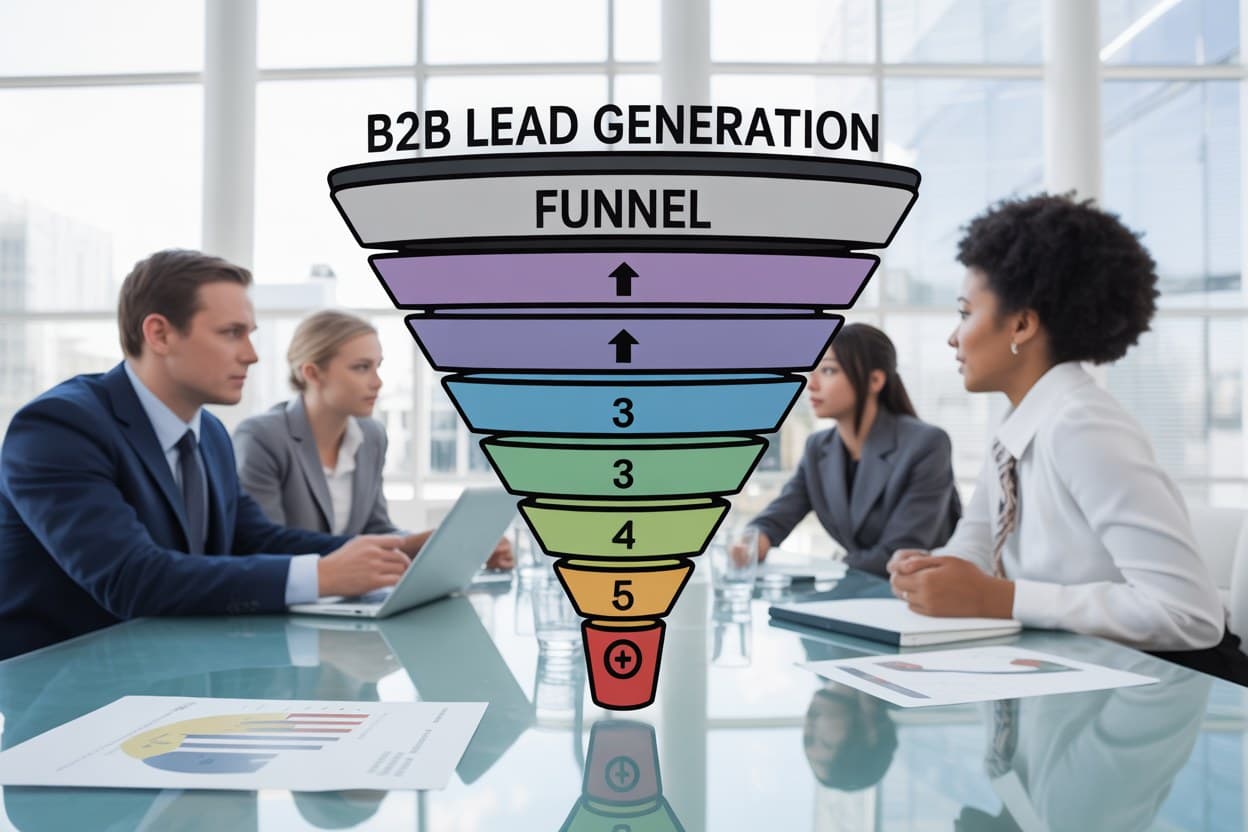
A 6‑stage framework – Awareness → Interest → Lead Capture → Qualification → Sales Opportunity → Customer Retention – powered by lead scoring, AI automation, and aligned sales‑marketing SLAs consistently outperforms random tactics, delivering predictable revenue and lower cost per client.
For US service agency owners and marketing leaders ready to move beyond sporadic lead inflow, this guide walks you through every stage of a scalable B2B lead generation funnel. You’ll learn how to capture high‑intent prospects, separate hot leads from noise, automate nurturing, and build systems that grow with your agency.
Short on time? Book a free funnel audit or download our lead scoring template.
Why B2B Funnels Are Different from E‑commerce
Unlike e‑commerce buyers who decide alone, B2B buying involves committees of 3‑10 decision‑makers. Sales cycles often stretch 6‑12 months, and trust is built through multiple personalized touchpoints – not impulse clicks.
Key differences we must account for:
-
Longer research phase – 67% of B2B buyers complete most of their research before ever talking to sales.
-
Multiple stakeholders – Your solution must appeal to executives, end‑users, and IT/security.
-
Higher price points – Decisions require budget approval and risk assessment.
-
Documentation drives growth – Agencies with documented funnel processes grow revenue 16% faster.
A proper B2B lead generation funnel structure transforms ad‑hoc activities into a repeatable, scalable system.
The 6 Stages of a Scalable B2B Lead Generation Funnel
1 - Awareness – Get Found Where Prospects Research
Your prospects discover solutions through SEO, paid search, LinkedIn, industry content, and referrals. To maximize visibility:
-
Invest in solutions‑oriented blog posts addressing specific pain points.
-
Optimize for B2B buyer journey keywords – not just high‑volume terms, but also comparison and problem‑aware queries.
-
Use programmatic SEO to create targeted pages for different industries or use cases.
-
Maintain an active presence on LinkedIn and industry forums where decision‑makers hang out.
2 - Interest – Build Engagement with Valuable Content
Once prospects land on your site, they evaluate whether you understand their problems. At this stage:
-
Create skimmable, informational content – short paragraphs, bullet points, and clear headings.
-
Use charts, screenshots, and data visualizations (no HTML tables).
-
Provide immediate answers to common questions, then offer deeper dives.
-
Include soft CTAs like “Read next” or “Download case study” – not pushy sales pitches.
3 - Lead Capture – Convert Visitors with Compelling Offers
Now you exchange value for contact information. Effective lead capture offers include:
-
Downloadable guides or checklists
-
Free consultation or strategy session
-
Newsletter with exclusive insights
-
Webinar or video series registration
Best practices:
-
Keep form fields minimal – name + email + company size is enough.
-
Offer multiple capture points across your site (sidebar, inline content, exit intent).
-
Use progressive profiling – ask for more data only after they engage further.
4 - Lead Qualification – Separate MQLs from SQLs
Not every lead is ready for sales. Use a dual scoring system based on fit and intent.
Fit score considers company size, industry, job title, and location (0–50 points).
Intent/engagement score tracks email opens, page visits, content downloads, and webinar attendance (0–50 points).
Then apply these score ranges:
-
0–30 points → Nurture (automated email sequence)
-
31–60 points → Marketing Qualified Lead (SDR outreach)
-
61–100 points → Sales Qualified Lead (direct to account executive)
Automate this with n8n or Make:
-
New lead arrives → Enrich with Clearbit → Calculate total score
-
If score > 60 → Push to CRM + send Slack alert + schedule discovery call
🔗 Deep dive: How to Build an Automated Lead Scoring System
5 - Sales Opportunity – Move Qualified Leads to Pipeline
Once a lead becomes an SQL, smooth handoff is critical. Sales reps need full context:
-
Engagement history (which content they consumed)
-
Lead score breakdown (fit vs. intent)
-
Notes from previous SDR conversations
-
Recommended next steps
Automated workflow:
-
CRM sends a notification to the assigned rep.
-
Calendar link is automatically generated.
-
A pre‑call questionnaire is sent (via Typeform) and answers are logged in the CRM.
Timing matters: Respond to SQLs within 5 minutes during business hours – conversion rates drop sharply after that.
6 - Customer Retention – Maximize Lifetime Value
Your funnel doesn’t end at the signed contract. Retention and expansion drive long‑term revenue.
Retention strategies:
-
Structured onboarding (first 30‑60‑90 days)
-
Regular business reviews (quarterly)
-
Educational content and customer‑only webinars
-
Referral program (reward clients who bring new business)
Metrics to track:
-
Customer churn rate (target less than 5% annually for agencies)
-
Net Revenue Retention (NRR) – top agencies achieve over 110%
-
Lifetime value (LTV) to CAC ratio (ideal greater than 3:1)
Proven Outbound Strategies That Generate Quality Leads
Cold Email with Hyper‑Personalization (AI‑powered)
We’ve moved beyond {{FirstName}} tokens. Today, we train AI agents on our solutions and case studies, then combine that with real‑time data scraped from prospect websites and LinkedIn. This creates uniquely relevant messaging.
Workflow example:
-
Scrape prospect’s “About Us” and “Services” pages.
-
AI summarizes their business model and pain points.
-
Match with your relevant case study.
-
Generate email: “I see you help SaaS founders with retention. We cut churn by 28% for a similar agency – here’s how.”
LinkedIn Prospecting & Social Selling
LinkedIn is not just a database – it’s a relationship platform. Effective tactics:
-
Engage with prospects’ content (comments, shares, voice notes).
-
Share your own expertise (2–3 posts per week).
-
Use connection requests with personalized notes.
-
After connecting, send a value‑first DM (no pitch).
Strategic Cold Calling (Research‑backed)
Cold calling still works – but only when it’s researched and relevant. Integrate calls into an omnichannel cadence:
-
Day 1: Personalized email
-
Day 3: LinkedIn connection + DM
-
Day 5: Cold call (reference the email)
-
Day 7: Follow‑up email with a case study
Pro tip: Leave voicemails only if you have something unique to say.
Inbound Strategies That Generate 3x More Leads
Content Marketing That Solves Problems
Create content for each funnel stage. For example:
-
Awareness stage: Blog posts, infographics – e.g., “Why agency sales cycles are getting longer”
-
Interest stage: E‑books, white papers – e.g., “The agency pricing model playbook”
-
Qualification stage: Case studies, webinars – e.g., “How we grew a PPC agency by 200%”
-
Sales opportunity stage: ROI calculators, proposal templates
SEO & AEO for B2B Buyer Journey
Optimize for both traditional search (Google) and answer engines (ChatGPT, Perplexity, Gemini):
-
Use question‑based headings (H2s and H3s).
-
Write bold direct answers in the first 30 words of each section.
-
Add FAQ schema to capture voice search snippets.
-
Target long‑tail, problem‑aware keywords.
Paid Media Acceleration
Retarget engaged visitors with automated ad campaigns:
-
Show different ads based on which pages they visited (e.g., pricing page vs. blog).
-
Use lookalike audiences from your best customer list.
-
Combine paid search (Google/Bing) with LinkedIn sponsored content.
Systems & Technology to Scale Your Funnel
Marketing Automation Platforms
Tools like HubSpot, Monday CRM, or Make handle lead capture, nurturing, and scoring. They give your team back 2+ hours per day by eliminating manual follow‑ups.
Set up trigger‑based sequences:
-
Prospect downloads a case study → Add to “warm nurture” sequence.
-
Prospect visits pricing page twice → Alert SDR for immediate call.
-
Prospect ignores emails for 30 days → Move to sunset sequence.
CRM Integration for Seamless Handoffs
Your CRM must be the single source of truth. Every lead, email, call log, and note should live in one place. Automations should:
-
Assign leads to reps based on territory or score.
-
Create tasks for follow‑ups.
-
Sync with calendar and email.
-
Enrich lead data automatically (Clearbit, ZoomInfo).
AI‑Powered Predictive Lead Scoring
AI analyzes historical conversion data to predict which new leads are most likely to close. This helps reps focus on deals ready to move, increasing win rates and shortening sales cycles.
Example tools: monday AI, 6sense, or custom n8n workflows.
Key Metrics & Continuous Optimization
Essential Funnel Metrics
For a healthy B2B service agency funnel, track these numbers:
-
Website to lead conversion – aim for 2–5%
-
MQL to SQL conversion – target 10–15%
-
SQL to opportunity conversion – target 20–25%
-
Win rate (proposal to close) – target 30–40%
-
Annual customer churn – keep below 5%
-
Net Revenue Retention – shoot for over 110%
Identify Breakdown Points
Use Google Analytics, heatmaps, and session recordings to see where prospects drop off:
-
Top of funnel – weak value proposition or poor targeting.
-
Middle of funnel – misaligned qualification criteria or slow follow‑up.
-
Bottom of funnel – weak discovery process or insufficient proof (case studies).
A/B Testing & Cohort Analysis
Test one variable at a time: headlines, CTA buttons, form lengths, email subject lines. Track cohorts of customers acquired in the same month to see seasonal trends.
Account‑Based Marketing (ABM) for High‑Value Prospects
For agencies targeting enterprise accounts ($50k+ contracts), ABM is essential.
ABM workflow:
-
Identify 50–100 ideal target accounts (ICP).
-
Personalize content for each account (e.g., “Acme Corp’s guide to agency scaling”).
-
Run hyper‑targeted LinkedIn and programmatic ads to those accounts.
-
Coordinate sales outreach (email, calls, direct mail) around account‑specific insights.
Scaling Your Team: SDRs, Outsourcing & Specialization
As your funnel grows, you’ll need dedicated roles:
-
SDR (Sales Development Rep) – handles outbound prospecting and qualifying inbound MQLs.
-
AE (Account Executive) – closes qualified opportunities.
-
Customer Success – manages retention and expansion.
Strategic outsourcing: Hire a specialized agency for appointment setting or lead research. This gives you access to seasoned strategists for the cost of one or two full‑time hires, with builtin scalability.
Frequently Asked Questions (FAQ)
1. What is the best B2B lead generation funnel structure for a small agency?
Start with a simplified 3‑stage funnel: Capture (blog + email opt‑in), Qualify (manual scoring using a spreadsheet), Convert (sales call). As volume grows, automate scoring and add the retention stage.
2. How long does it take to build a scalable funnel?
A basic version can be set up in 1–2 weeks. Full automation with lead scoring, CRM integration, and nurturing sequences takes 4–6 weeks.
3. What’s the most common reason B2B funnels fail?
Misalignment between marketing and sales. Marketing pushes leads that aren’t sales‑ready, and sales ignores leads that need nurturing. The fix is implementing shared SLAs and closed‑loop reporting.
4. Which tools do you recommend for a low‑budget agency?
-
n8n (self‑hosted) – free automation
-
HubSpot CRM – free tier
-
Google Sheets – store scores and track metrics
-
Typeform – free lead capture
5. How do I measure ROI from my funnel?
Track total cost of acquisition (ads + tools + salaries) divided by number of new clients. Also measure LTV (average revenue per client × average retention months). Healthy agencies achieve LTV greater than 3 times CAC.
Final Decision Framework
Based on your team and budget, focus on these areas:
-
No technical staff – Focus on Capture + manual qualification using Typeform and CRM.
-
A small ops team – Capture + automated scoring (n8n or Make).
-
A developer or automation specialist – Full 6‑stage funnel with predictive AI and ABM.
-
Budget under $500/mo – n8n self‑hosted + free HubSpot + Google Sheets.
-
Budget over $2,000/mo – Enterprise CRM + dedicated SDRs + paid ads retargeting.
Our recommendation for most US service agencies:
Start with n8n Cloud free tier + HubSpot CRM free. Once you hit 100 qualified leads/month, migrate to self‑hosted n8n ($20/mo server) and upgrade to a paid marketing automation platform.
📞 Ready to fix your funnel? Book a free funnel audit – we’ll analyze your current breakdown points and give you a custom action plan.